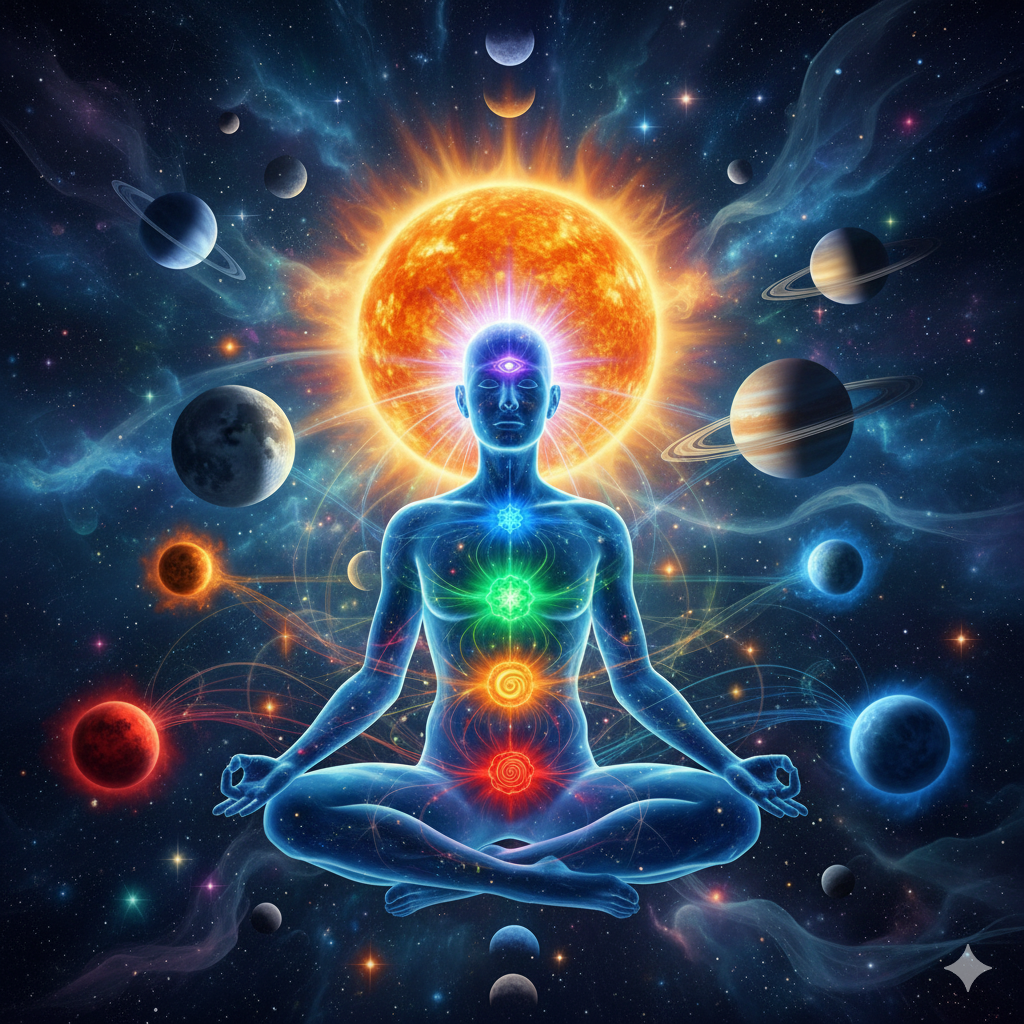
Celestial Harmony between Planets, Chakras and the Human Body – When the Cosmos Meets Body and Soul
Since the dawn of time, human beings have looked up at the starry sky and sought to understand their place in the universe. Astrology, a sacred and ancient science, was born from this profound contemplation. The Babylonians observed planets and their cycles with precision, the Egyptians linked the lives of pharaohs to the stars, and the ancient Greeks, like Pythagoras and Hippocrates, saw correspondences between celestial movements and human health, emotions, and destiny. Lunar cycles were particularly observed: the Moon governs tides, influences crops and seeds, and accompanies our bodily and emotional rhythms. Understanding these cycles means recognizing that we are part of a whole, and that our bodies, emotions, and energies resonate with the cosmos.
Each planet is connected to a chakra, an energetic center of the body, and exerts its influence on our vitality, emotions, and consciousness. The Sun governs the solar plexus (Manipura), center of will and digestion. The Moon rules the sacral chakra (Svadhisthana), seat of emotions, creativity, and reproduction, and its phases — new moon, waxing moon, full moon, waning moon — modulate our moods, hormonal cycles, and sensitivity. Mars energizes the root chakra (Muladhara), source of vital energy and inner security. Jupiter illuminates the heart chakra (Anahata), fostering compassion and expansion. Venus acts on the throat chakra (Vishuddha), linked to expression and communication, while Saturn opens the third eye (Ajna), center of intuitive perception and wisdom. Uranus and Neptune radiate on the crown chakra (Sahasrara), seat of spiritual consciousness and connection to the infinite.
Planetary transits and lunar phases activate or imbalance these chakras. A full moon can reveal emotional tensions or amplify sensitivity, while a new moon is conducive to renewal and introspection. A Saturn transit over the heart chakra can bring lessons or relational blockages, while a Jupiter transit invites expansion, openness, and healing. Astromedicine proposes observing these correspondences to understand physical and emotional imbalances, and harmonize them consciously. Digestive troubles may reflect a solar plexus imbalance, emotional fluctuations a sacral chakra blockage, and breathing difficulties a heart imbalance.
But astrology is not limited to being a therapeutic tool. It invites us to reflect on our place in the universe and our relationship with ourselves. Imagine a society where children and young people would learn, from an early age, to know their inner rhythms, to observe their emotions, to understand their strengths and vulnerabilities through Moon cycles and planetary influences. Imagine that meditation, energetic awareness, and astrology were part of fundamental teachings. This would profoundly transform our world. A society where everyone learns to listen to themselves, understand themselves, and harmonize with the universe could generate more balance, empathy, and collective wisdom.
Today, understanding the link between the stars and our body, between cosmic cycles and our chakras, is an invitation to rethink our health, education, and way of living together. It is a call to envision a world where heart intelligence and energetic consciousness are not abstract notions, but pillars of our existence. And if we started right now, by teaching our children to harmonize with themselves and with the cosmos, the world could transform more deeply and rapidly than we imagine.
Explore further:
- Giani, P. (2016). Les Planètes et les chakras. Jupitair.
- Sripathi, A. (2019). Relationship between Chakras in Human body, Planets and Medical Astrology. Anil Sripathi.
- Chamunda Swamiji. (2020). Vedic Astrology and Health: The Role of Planets and Chakras. Chamunda Swamiji.
- Ananda. (2016). Astrology: What Is The Relationship Between the Human Body and the Planets?. Ananda.
- France Minéraux. (n.d.). Les Planètes en Astrologie – Significations, symboles et influences. France Minéraux.