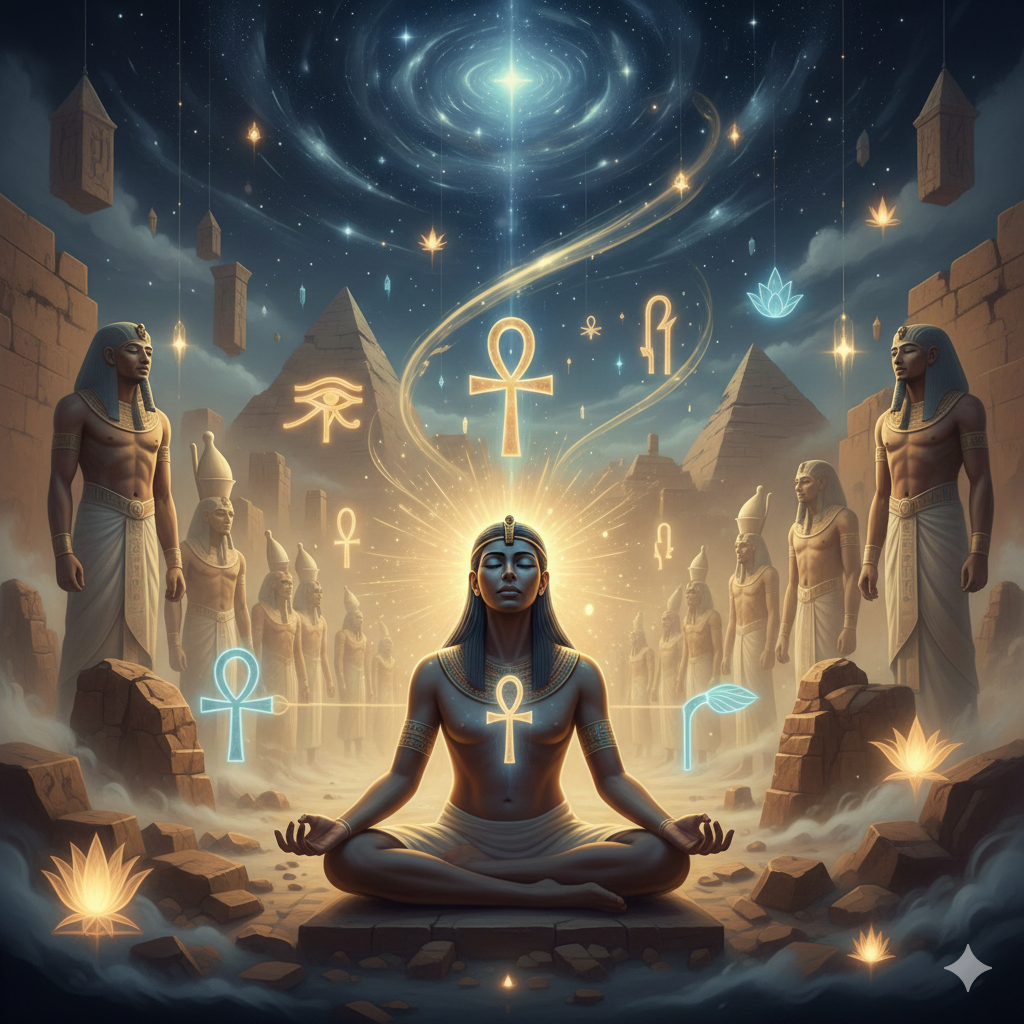
The Pharaohs Within Us
Egypt has always fascinated. Its pyramids, temples, and hieroglyphs seem to speak of a time when man was in direct connection with the sacred, where each gesture, each ritual, each symbol carried within it millennial knowledge. But it is not only in stones and museums that Egypt still lives: it also inhabits our unconscious.
In The pharaohs survive in us, Georges Romey, a French psychologist and researcher passionate about dreams and the collective unconscious, explores this idea through more than 1,200 sessions of "free waking dream." The subjects, immersed in an altered state of consciousness, expressed images and symbols that seem to transcend time. The recurring scenes – temples, ceremonies, royal and initiatory figures – are not simple inventions of the imagination: they belong to a collective memory that connects us to the initiates of the Ancient Egyptian Empire. Romey proposes several hypotheses to explain this recurrence: phylogenetic memory, that is, a memory inherited from our ancestors that preserves certain universal experiences and archetypes, the role of "ka" and the permanence of initiatory archetypes in the human unconscious. These symbols are not fixed: they invite us to recognize within ourselves a part of this ancient wisdom, to explore our own initiatory path.
The ka, which Romey evokes in his work, deserves particular development. In Egyptian tradition, the ka is the vital energy that animates every human being, the breath that makes the body exist and that connects man to the divine. In pharaohs, it takes on a more manifest dimension, symbolizing their role as mediators between heaven and earth and their ability to guide the people. The ka can survive after death, be nourished by rites and offerings, and continue to influence the living. Thus, it is not only a spiritual force of the pharaohs, but an essential component of the human soul, present in each of us, which invites awakening and inner transformation.
Elizabeth Haich, Hungarian writer and spiritual teacher, plunges us into the very heart of this wisdom in her book Initiation. She recounts her journey as an initiate and that of her master, revealing how the pharaohs and priests of the Ancient Empire had developed a profound understanding of the laws of spirit and soul. Through meditation, discipline, and mastery of sacred symbols, the initiates accessed a state of awakened consciousness, capable of perceiving the subtle forces that govern the universe. Haich describes the pharaohs as spiritual guides, beings capable of harmonizing body, soul, and spirit, and of transmitting initiatory knowledge destined to awaken human consciousness.
René Lachaud, French Egyptologist and author specialized in esotericism and Egyptian initiatory tradition, enriches this perspective in his book Magic and initiation in pharaonic Egypt. He describes the rituals, the symbolism of temples and pyramids, and explains that the pharaohs were not only sovereigns, but masters of meditation and inner magic. His analyses of the ka allow us to better understand what Romey glimpses in the collective unconscious and what Haich experiences in initiation: this vital and spiritual energy, both universal and intensified in the pharaohs, is a thread connecting individual experience to humanity's ancestral memory.
By bringing together the three approaches, we see a thread emerging between observation, experience, and documented tradition: Romey shows us that images and symbols persist in our psyche; Haich immerses us in the lived dimension of initiation; Lachaud explains the structure, logic, and meaning of these rites and forces. Together, they reveal that the pharaohs within us are not only symbols frozen in the past, but guides, energies, and archetypes capable of leading us toward inner awakening.
As Romey emphasizes, the "ka" are not simple vestiges of the past: they still vibrate in our unconscious and invite us to awaken our own consciousness. Haich, for her part, recounts the living experience of these millennial initiations: she remembers the rituals and teachings of the pharaohs, and these memories become a light that illuminates the present. Thus emerges a profound truth: the pharaohs within us are not dead figures of history, but living forces, guides toward consciousness, toward the harmonization of body, soul, and spirit, and toward understanding the mysteries that connect man to the divine.