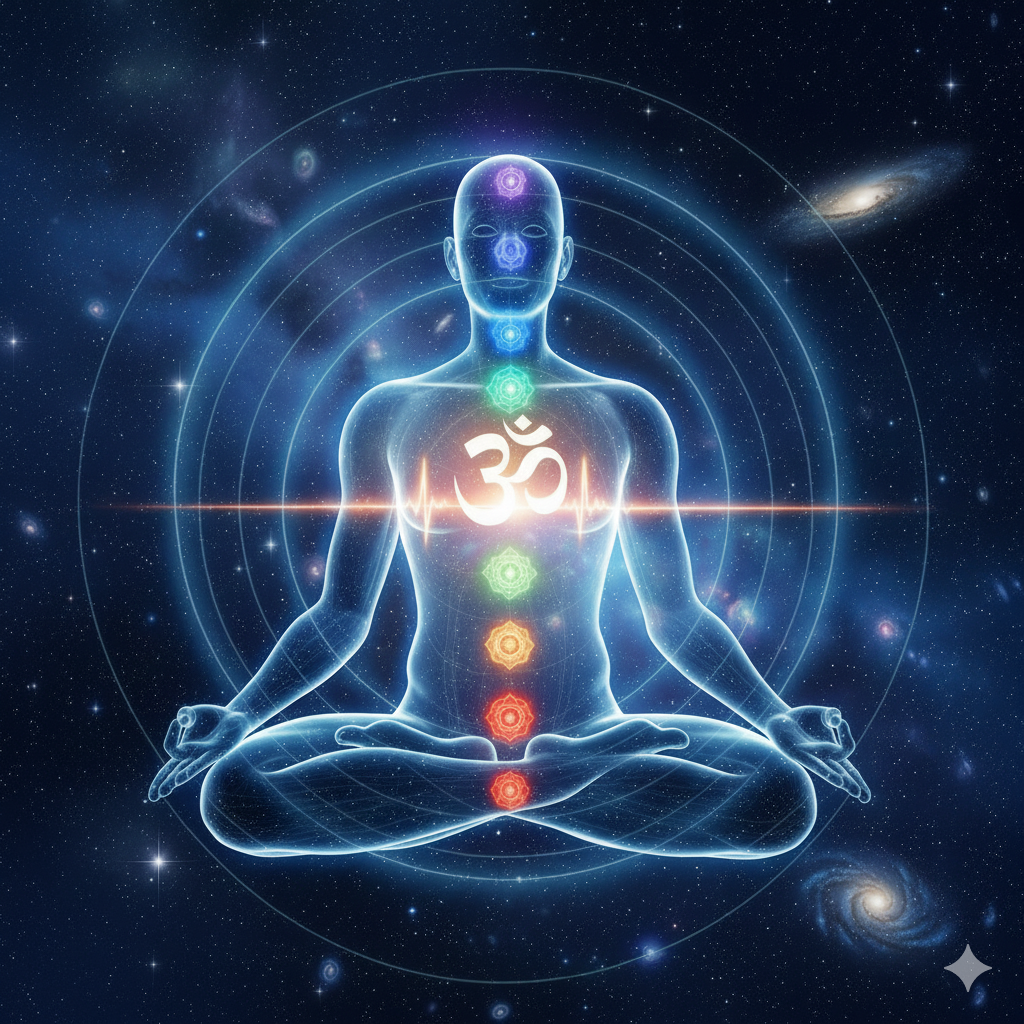
"Om is all that was, all that is and all that will be. " – Mandukya Upanishad, verse 1
The sound OM, or AUM, is recognized in spiritual traditions as the primordial vibration of the universe. More than a simple mantra, it is considered the original source of all creation, encompassing the past, present and future. This sacred syllable is at the heart of many meditative and yogic practices, serving as a bridge between the material and spiritual worlds.
Recent scientific studies have explored the physiological and neurological effects of chanting OM. A study published in Frontiers in Psychology revealed that the practice of chanting OM reduced activity in the amygdala, a brain region associated with emotion management, particularly fear and anxiety. This reduction in amygdala activity suggests that chanting OM can induce a state of calm and deep relaxation.
Frontiers "The conscious repetition of OM purifies the body, calms the mind and opens the heart. " Alice Bailey — A Treatise on Cosmic Fire, 1925
Another study observed that regular practice of chanting OM improved heart rate variability, a key indicator of autonomic nervous system health. This improvement suggests that chanting OM promotes balance between the sympathetic and parasympathetic nervous systems, thus contributing to better stress management and increased relaxation.
PMC « The sound Om is the breath of the cosmos; repeat it with attention and it will awaken in you the consciousness of the Infinite. » Swami Vivekananda (1863‑1902) — Lectures on Raja Yoga, 1896)
Since the most ancient times, the sound OM — or AUM — resonates as the breath of creation. In the Vedas, it is described as the primordial syllable, the source of all vibration. This sound is not reduced to a simple recitation: it is the breath of the world, the pulsation of consciousness itself.
Today, modern science is rediscovering what the ancients knew intuitively: sound has a power of coherence. And OM seems to be its archetype.
Research in neuroscience, physiology and psychology shows that chanting OM acts directly on the brain, heart and autonomic nervous system. In other words: chanting OM changes our biology — deeply, gently.
"Repeat OM with consciousness turned toward your inner center; you will harmonize your thoughts and emotions. " Paramahansa Yogananda (1893‑1952) — Autobiography of a Yogi, 1946)
Studies conducted with brain imaging (functional MRI) have shown that conscious recitation of OM deactivates brain areas associated with stress and fear (notably the limbic and orbitofrontal regions). This deactivation is similar to that observed during deep meditative states — confirming that OM acts as rapid access to inner tranquility.
EEG recordings have also revealed an increase in theta waves after a few minutes of meditation on OM, typical of states of relaxation and inner attention.
On the cardiac level, regular practice of OM increases heart rate variability (HRV), a sign of better parasympathetic balance and nervous system relaxation.
Finally, studies in emotional psychology show that chanting OM reduces negative affect and promotes emotion regulation, opening a space of mental clarity and compassion.
What fascinated the sages thus finds a measurable echo: the sound OM harmonizes body and psyche. It creates a resonance between breath, word and universal vibration — unifying what in us was separated.
« The sound AUM, when pronounced with purity and understanding, awakens in man the presence of his Higher Self, the "inner Father". » — H.P. Blavatsky, Transactions of the Blavatsky Lodge (1889)
Integrating the chanting of OM into daily practice can be a powerful path toward inner balance. Whether at the beginning of a meditation session, during yoga sessions or simply as a conscious pause in the day, OM offers an accessible means of recentering and connecting with oneself. Its simplicity and depth make it a precious tool for those seeking to deepen their spiritual practice and cultivate conscious presence in their daily life.
« OM or AUM… is the origin of the word Amen, later borrowed by the Hebrews and Greeks from the Chaldeans. » — H.P. Blavatsky, Isis Unveiled, vol. II (1877)
References and readings
Scientific studies:
- Meditation on OM: relevance of ancient texts and modern evidence — S. Kumar, Indian Journal of Physiology and Pharmacology, 2010.
- Neurohemodynamic correlates of "OM" chanting: a pilot study — B. G. Kalyani et al., International Journal of Yoga, 2011.
- EEG spectral analysis of OM mantra meditation: a pilot study — B. P. Harne et al., Journal of Clinical and Diagnostic Research, 2018.
- Immediate effects of OM chanting on heart rate variability (HRV) — G. Inbaraj et al., Indian Journal of Physiology and Pharmacology, 2022.
- OM chanting modulates processing of negative stimuli — Z. Zhang et al., Frontiers in Psychology, 2022.
Books and complementary literature:
- Om — The sound of the universal primordial mantra, Dick de Ruiter and collective, Éditions Le Souffle d'Or.
- Om: the primordial syllable, Roberto Caputo, Éditions Véga.
- The science of sacred sound — Mantras, frequencies and consciousness, Jonathan Goldman, Éditions Le Souffle d'Or.
- Nada Yoga: the path of inner sound, Alain Daniélou, Éditions Fayard / Albin Michel.